
Johor Launches Maharani Freeport Muar — A 3,200-Acre Deep-Water Free Zone Set to Redefine Regional Energy & Maritime Trade
Johor has officially launched the 3,200-acre Maharani Freeport, a next-generation deep-water free zone in Muar strategically positioned along the Strait of Malacca—one of the world’s busiest maritime routes. The project, led by Maharani Energy Gateway Sdn Bhd (MEG), is designed to power Malaysia’s expansion into global energy logistics, oil and gas trading, and deep-sea port operations.
The inauguration took place on Saturday and was officiated by His Majesty Sultan Ibrahim Sultan Iskandar, with Prime Minister Datuk Seri Anwar Ibrahim and federal ministers in attendance. With government approval now fully gazetted, the Maharani Freeport is officially “open for business.”
This mega development marks one of Johor’s most ambitious economic catalysts and is poised to elevate Malaysia’s standing as a regional energy and maritime powerhouse.
A Three-Island Deep-Water Free Zone Designed for Global Energy Trade
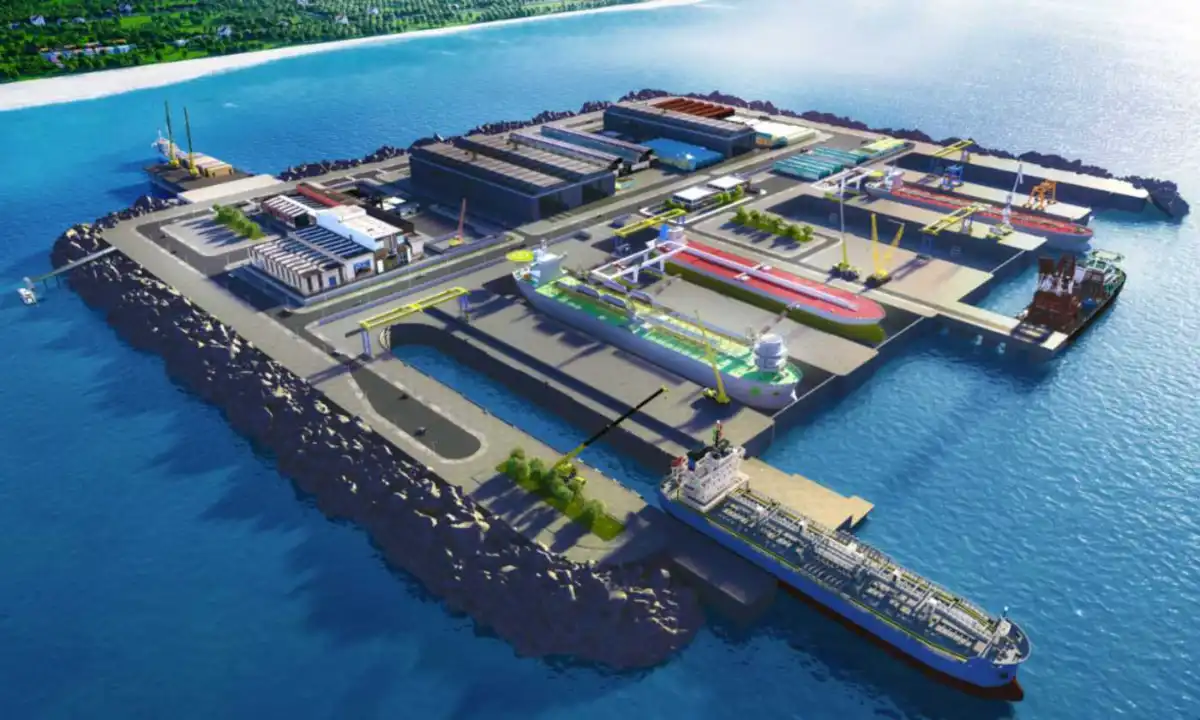
The Maharani Freeport spans three reclaimed islands and a mainland energy hub, situated within the Muar Port limits. It is engineered as a high-capacity deep-water maritime facility with natural depths exceeding 24 metres, capable of receiving Very Large Crude Carriers (VLCCs)—a rare advantage in the Malacca Strait.
According to project documents, the Freeport consists of:
-
Three reclaimed islands housing maritime, storage, and energy facilities
-
Mainland industrial zone with an energy hub and logistics infrastructure
-
Deep-sea port terminals built for global oil and gas movement
-
Integrated financial and commercial zones
-
Industrial parks supporting manufacturing, petrochemicals, and ship repair activities
MEG serves as the master developer, landowner, and deep-sea port operator, with its own dedicated freeport authority for governance and investor facilitation.
Free-Zone Incentives to Rival Global Hubs
The Maharani Freeport is structured to attract global industry players through competitive incentives such as:
-
Full tax exemptions on qualifying energy and maritime operations
-
Import-duty exemptions on most raw materials, machinery, and equipment
-
100% foreign ownership (subject to regulatory conditions)
-
Unrestricted capital repatriation
-
Fast-track approvals via a one-stop investor facilitation centre
These incentives position Maharani Freeport to compete not only with Malaysian industrial corridors but also with Singapore and other ASEAN maritime hubs.
The goal is clear: transform Muar into a major node for energy trade and logistics within the Malacca Strait—a passage that hosts over 100,000 vessels annually and handles nearly 25% of global seaborne oil trade.
Core Activities: A Full Spectrum of Energy & Maritime Operations
The Maharani Freeport is planned to support a comprehensive suite of activities across the energy and maritime value chain:
1. Oil & Gas Trading Hub
With natural deep-water access, the port will facilitate high-volume crude and refined product trade.
2. Product Storage Terminals
Large-scale tank farms for crude, refined products, LNG, LPG, and petrochemicals.
3. Ship-to-Ship (STS) Operations
A fast-growing segment of global maritime trade due to the Malacca Strait’s strategic position.
4. Refinery & Petrochemical Complexes
Complementing existing downstream ecosystems on the east coast, such as the Pengerang Integrated Petroleum Complex (PIPC).
5. LNG Floating Terminal & Bunkering Facilities
Supporting the region’s LNG adoption and greener fuel transition.
6. Ship Repair & Marine Engineering Yards
Offering regional ship maintenance and repair capabilities.
MEG executive chairman Datuk Dr Daing A Malek confirmed that “the project is already doing business” and that investor interest is high.
Creating 45,000 New Jobs & Transforming the Local Economy
The Maharani Freeport is expected to generate at least 45,000 direct and indirect jobs, according to projections by MEG. These opportunities will support sectors such as:
-
Maritime logistics
-
Ship repair and engineering
-
Oil and gas downstream industries
-
Port operations
-
Construction and infrastructure
-
Services, hospitality, and retail
For Muar, traditionally known for furniture manufacturing, this represents a significant economic pivot into high-value, high-technology industries.
Strategic Alignment With Johor’s Energy Corridor Vision
Johor already hosts one of Southeast Asia’s largest integrated petrochemical complexes on its east coast—the Pengerang Integrated Petroleum Complex (PIPC), comprising:
-
Over 6,000 acres of downstream facilities
-
The PETRONAS Pengerang Integrated Complex
-
Refineries, petrochemical plants, storage terminals, and LNG facilities
The Maharani Freeport complements PIPC by establishing a west-coast counterpart focused on deep-water trade, STS operations, and high-capacity maritime logistics.
This dual-coast strategy strengthens Johor’s overall positioning as Malaysia’s leading energy and maritime investment hub.
A Magnet for Domestic & Foreign Investment
Prime Minister Anwar Ibrahim emphasised that Maharani Freeport’s official free-zone status—gazetted on Nov 28—signals Malaysia’s commitment to private-sector–driven, globally competitive economic zones.
The Freeport is expected to draw:
-
International oil majors
-
Regional logistics players
-
Shipyard operators
-
Petrochemical producers
-
Commodity traders
-
Maritime engineering firms
With 100% foreign ownership allowed under specific conditions, the development targets global capital and strategic partnerships.
Impact on Johor’s Property & Industrial Market (KLPROPERTY.cc Insight)
For the property and industrial sectors, Maharani Freeport introduces several transformative effects:
1. Rising Demand for Industrial & Commercial Properties
Logistics, warehousing, petrochemical, and engineering industries will trigger demand for factories, industrial lots, and commercial offices.
2. Increased Housing Demand in Muar & Northern Johor
The 45,000 projected job opportunities will drive new residential developments targeting middle-income and professional segments.
3. Long-Term Land Value Appreciation
Large-scale economic catalysts typically uplift real estate values across a 10–20 km radius, benefitting landowners and developers.
4. Strengthening Johor’s Position as Malaysia’s Fastest-Growing Economic State
Alongside Forest City, Ibrahim International Business District, PIPC and JS-SEZ, Maharani Freeport expands Johor’s multi-core economic engine.
Conclusion: A New Global Gateway for Malaysia
The Maharani Freeport Muar project marks a bold new chapter for Johor and Malaysia. With deep-water access, strong government backing, competitive free-zone incentives, and a strategic location along the Malacca Strait, the Freeport stands to become a major hub for energy, trade, and maritime activity in Southeast Asia.
For investors, businesses, and the property sector, Maharani Freeport opens new frontiers of opportunity—solidifying Johor’s rise as a powerhouse in regional economic development.


