Menara Haw Par RM132 Million Sale Completed as KL’s Golden Triangle Evolves
The RM132 million sale of Menara Haw Par in Kuala Lumpur has been completed, placing the 32-storey commercial tower along Jalan Sultan Ismail under a new ownership structure as investors reassess older office buildings in the Golden Triangle.
Singapore-listed Haw Par Corporation Ltd confirmed the completion of its disposal of Haw Par Land (Malaysia) Sdn Bhd on 2 November 2026, following a share purchase agreement signed with JD Hotels (Jalan S Ismail) Sdn Bhd on 2 October.
The transaction involves the entire equity interest in Haw Par Land (Malaysia), which owns Menara Haw Par and two associated freehold land parcels at 12 Jalan Sultan Ismail.
The acquisition is particularly noteworthy because companies associated with the purchaser have previously participated in the conversion of older Kuala Lumpur office buildings into hospitality developments.
However, no confirmed redevelopment plan has been announced for Menara Haw Par itself.
JD Hotels Acquires Menara Haw Par Through RM132 Million Transaction
Under the October agreement, JD Hotels agreed to acquire all 64.3 million ordinary shares in Haw Par Land (Malaysia) for RM132 million in cash.
The payment structure comprised an initial RM13.2 million deposit and a remaining RM118.8 million payable upon completion.
The transaction effectively transfers control of the property-holding company, rather than representing a conventional direct sale of the building alone.
The assets include the 32-storey Menara Haw Par and two land parcels identified as Lots 1226 and 242 in Bandar Kuala Lumpur.
According to Haw Par’s property disclosures, the building occupies a land area of approximately 2,636 sq m, with another commercial land parcel measuring approximately 1,294 sq m.
Menara Haw Par provides around 16,131 sq m of lettable space, equivalent to approximately 173,600 sq ft.
For Haw Par Corporation, the disposal represents an opportunity to realise value from its longstanding Malaysian property investment.
For the purchaser, the transaction provides control of an established commercial asset within one of Kuala Lumpur’s most recognisable business districts.
JD-Linked Companies Have Experience in Hotel Conversion
The identity of the purchaser adds an interesting dimension to the transaction.
JD Hotels (Jalan S Ismail) shares common directors with JD Hospitality Sdn Bhd, a company previously involved in acquiring and repositioning commercial property in Kuala Lumpur.
In December 2020, JD Hospitality acquired the former 21-storey Menara MIDF along Jalan Raja Chulan from Permodalan Nasional Bhd for RM140 million.
The property was subsequently transformed into an integrated hospitality and healthcare development incorporating YOTEL and a medical centre.
The redevelopment carries an estimated investment value of approximately RM200 million and includes a planned 290-room hotel.
According to the October 2026 market report, the hotel component was targeting completion in December 2026, while the medical centre was scheduled for 2027.
The connection between the two purchasing entities makes Menara Haw Par’s future use worth monitoring.
Nevertheless, previous hotel conversion experience does not establish that the new owner intends to adopt the same approach for Menara Haw Par.
Any change of use would require an appropriate commercial strategy, technical assessment and regulatory approvals.
Jalan Sultan Ismail Remains an Important Commercial Address
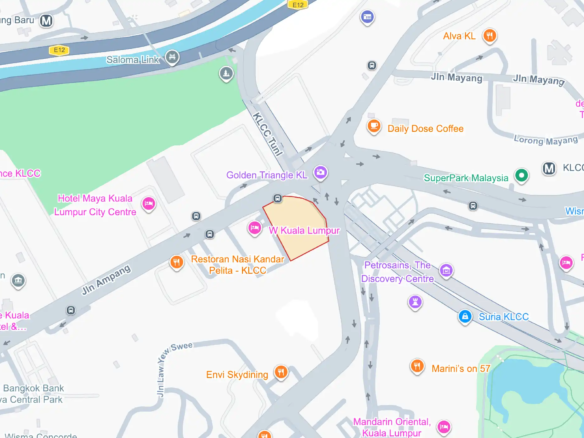
Menara Haw Par is located along Jalan Sultan Ismail, within Kuala Lumpur’s Golden Triangle commercial corridor.
The area connects major business and visitor destinations, including KLCC, Bukit Bintang and Jalan Raja Chulan.
Its established urban environment includes corporate offices, hotels, shopping destinations, public transport connections and commercial services.
For investors, these characteristics provide several potential uses for centrally located properties.
An existing office building may continue generating rental income, undergo refurbishment to attract new tenants, or be assessed for alternative commercial uses.
The underlying freehold land can also become an important consideration, particularly where redevelopment opportunities in established central locations are limited.
However, location should be assessed together with the building’s actual condition, occupancy, accessibility and investment requirements.
A centrally located tower is not necessarily commercially attractive if substantial expenditure is required to make it competitive.
Older Golden Triangle Offices Face New Market Expectations
The Menara Haw Par transaction forms part of a broader pattern of commercial property activity in central Kuala Lumpur.
Other notable transactions and proposals include the planned disposal of Menara AmBank, the marketing of Menara Tun Perak, formerly Menara Maybank, and new development arrangements involving centrally located commercial land.
Some existing buildings are being considered for refurbishment, while others have attracted attention for hotel or mixed-use repositioning.
Hospitality developments such as Hyatt Centric and the planned Conrad and YOTEL hotels also illustrate how parts of the traditional office district are diversifying beyond conventional corporate accommodation.
At the same time, newer office destinations such as Tun Razak Exchange (TRX) have introduced modern buildings with updated specifications, transport integration and contemporary workplace facilities.
This creates additional competition for older office towers.
Occupiers increasingly assess energy efficiency, internal layouts, building services, workplace amenities and long-term operating costs alongside rental rates.
According to industry commentary reported by The Edge, investor interest in Kuala Lumpur’s commercial property market remains selective rather than representing a uniform recovery.
This distinction matters because the commercial prospects of individual buildings can vary considerably even within the same district.
Could Menara Haw Par Become Another Hotel Development?
Hotel conversion is one possible strategy for some older commercial buildings in the Golden Triangle, but its feasibility cannot be determined by location alone.
An office-to-hotel conversion may require substantial modifications to plumbing, drainage, fire safety systems, ventilation, lifts and internal circulation.
The building’s floor plates, structural configuration and capacity to accommodate guest facilities must also be considered.
Developers would need to evaluate the cost of refurbishment against expected room rates, occupancy, operating expenses and competition from existing hotels.
Alternatively, retaining Menara Haw Par as an office building with targeted upgrades could be viable if refurbishment costs and tenant demand support the investment.
Redevelopment of the underlying land represents another possibility, subject to planning controls and financial feasibility.
At present, these remain potential scenarios rather than announced plans for the property.
Menara Haw Par Reflects a Changing KL Commercial Property Market
The completed RM132 million transaction demonstrates that established Kuala Lumpur office buildings continue to attract purchasers with different investment strategies.
For the Golden Triangle, the more significant development is the growing importance of asset quality and the potential to reposition older commercial properties.
Menara Haw Par’s new ownership adds another property to watch alongside the evolving hotel, office and mixed-use development pipeline around Jalan Sultan Ismail and Jalan Raja Chulan.
The next meaningful milestone will be clarification of JD Hotels’ plans for the building, including whether it will remain an office investment or undergo a more substantial transformation.
Until then, the transaction is best understood as a completed commercial property acquisition that illustrates changing investor priorities in central Kuala Lumpur, rather than confirmation of another hotel conversion.